What "Web Designer Near Me" Actually Gets You
Google ranks local results partly on distance — that part works exactly as you expect. The question is whether distance does anything useful for this particular purchase.
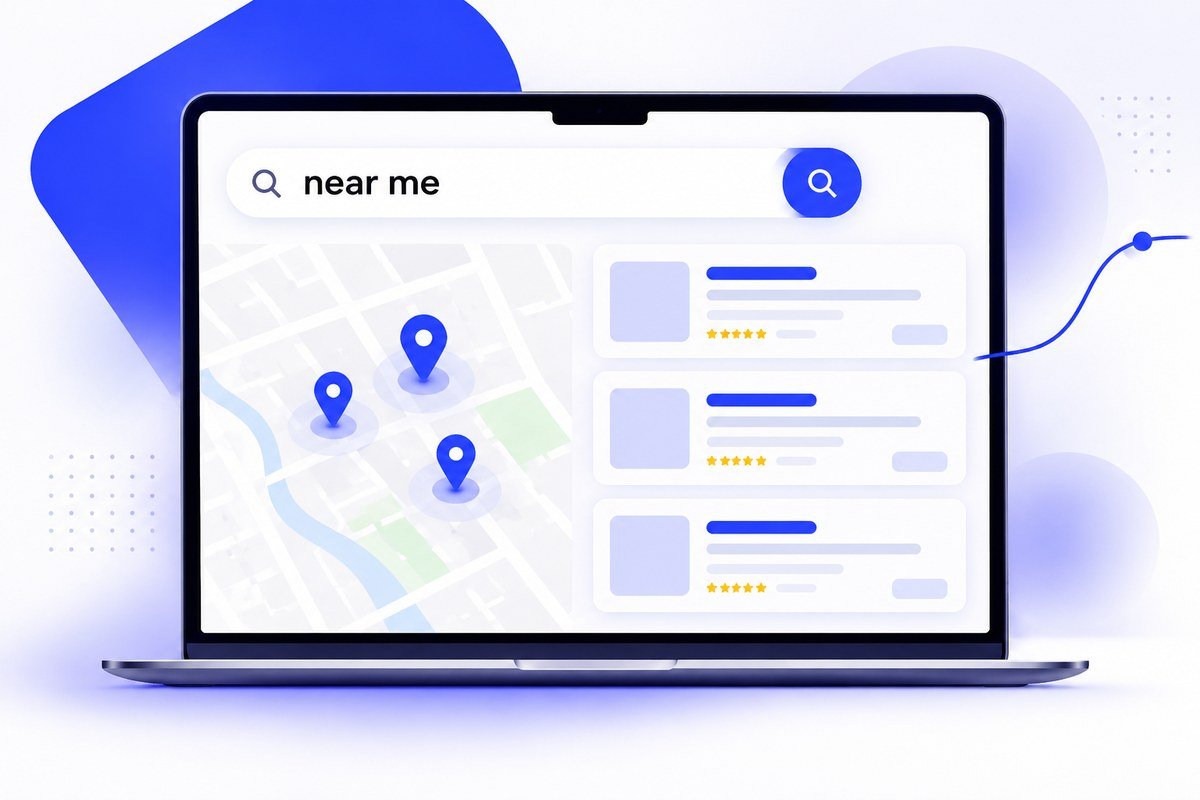
Google says local results are mainly based on three things: relevance, distance and prominence. Distance is on that list. So in the map pack at the top of a "near me" search, the listings really are ordered partly by how close each business sits to wherever Google thinks you are. That part is working as designed. It also covers only that block — the ordinary results below it are ranked the ordinary way. The more useful question is whether distance is buying you anything on this particular purchase, because almost nothing involved in building a website is delivered in person.
A "near me" search puts nearby businesses in the map pack because distance is one of the three things Google says local results are mainly based on, alongside relevance and prominence. Proximity genuinely helps with on-site photography, same-jurisdiction contracts, knowledge of your local market and verifying a supplier exists, but it has no bearing on code quality, page speed or whether you end up owning the site.
What the Search Engine Is Actually Doing
Take those three in turn, in Google’s own terms. Relevance is how well a business listing matches what someone searched for. Distance is how far the business sits from whoever is searching — and when the searcher has not said where they are, Google uses whatever location data it holds. Prominence is how well known a business is, which Google says draws partly on how many other sites link to it and on its review count and ratings. Google does not say what feeds relevance beyond matching the search, so nobody outside Google can tell you what is in there. What can be said is that nothing in the three it names is a measure of how well a studio builds things. Distance certainly is not. Google also states there is no way to request or pay for a better local ranking, which is worth knowing before anyone sells you one. The local pack is an excellent tool for finding a dentist.
What Being Nearby Genuinely Buys You
Four things, and they are real. Original photography is the big one. If your site needs pictures of your premises, your team or your work, someone has to physically stand there with a camera, and a supplier two hours away either charges for travel or works from whatever you can send them. Second, a contract between two businesses in the same jurisdiction is simpler to enforce, and that matters more as the project value climbs.
Third is market knowledge, and this is the one a remote supplier cannot buy its way around. Someone working in your town has seen what your competitors put on their homepages and what a customer there expects before they will call. A remote supplier can learn that, but it has to be learned deliberately, and you should make them show you rather than take the claim. Fourth, and least discussed, you can confirm they exist. Driving past an address is a crude verification method and it still works.
“Proximity solves a short, specific list of problems. It is worth knowing whether any of them are yours before it narrows the field for you.”
What It Does Not Buy You
Most of what decides whether the site is any good. Page speed comes out of how the site was assembled, not where the person assembling it was sitting — our page on Core Web Vitals goes through why that is a build problem, not a map problem. Nobody checked the contrast ratios: that is all an accessibility failure has ever been. Ownership comes down to one line in a domain registration record, and almost nobody asks about it until the relationship ends badly — we wrote a whole piece on who actually owns your website because the answer is so often "not the person paying for it". Responsiveness is about how a business runs its inbox, and a studio in your town can be slower to reply than one eight time zones away.
The Questions That Separate Suppliers, Wherever They Are
Ask who will be listed as the registrant on the domain. Ask whose name the hosting account is in. Ask what transfers to you on final payment — the files, the content, the design source, the analytics property — and get the answer in writing rather than in a reassuring sentence on a call. Ask what you will be paying monthly in three years’ time. Ask whether anything stops working if you stop paying. Then ask to see two sites they built more than a year ago, and check them yourself on a phone. Those five answers will tell you more than any amount of proximity, and they cost nothing to ask.
When You Should Insist on Local
If the site needs photographs of your premises, your staff or your finished work, hire someone who can get there, or budget separately for a photographer who can. If you genuinely want to sit in a room and point at a screen — some people think better that way, and there is nothing wrong with it — then say so up front, because a remote supplier cannot give you that no matter how good the video calls are. And if the contract value is high enough that you would want straightforward legal recourse, keeping it in one jurisdiction is a reasonable thing to want. Outside those cases, a radius is just a filter that removes candidates without telling you why.
Where We Sit, Stated Plainly
We work remotely and hold no local listing, so we do not appear in the map pack at all. That is what the map pack is for, and we are not it — where we turn up is the ordinary results underneath it. The honest version of what that costs you: we cannot photograph your premises, we cannot sit in your office, and if you are in California our working day has largely finished by the time yours begins. What it gets you is that there is no account-manager layer to pay for, which is a large part of why our builds start at $1,199 as a one-time cost with the site transferring to you on final payment. If what you actually needed was someone down the road with a camera, that is a real requirement and we would rather you found them. If what you needed was a site that loads fast and belongs to you, distance was never the variable.
Key Takeaways
- Google states that local results are mainly based on relevance, distance and prominence — so a "near me" search weighs proximity by design, not quality.
- Prominence is partly review count and how many sites link to a business, which favours established firms over better ones.
- Being nearby genuinely helps with original photography of your premises, contracts under one jurisdiction, knowing your local market, and simply confirming the supplier is real.
- It has no effect on code quality, page speed, accessibility or whether the finished site transfers to you.
- The questions that separate suppliers — who registers the domain, what transfers on final payment, what the monthly cost is in year three — are the same either way.
- Insist on local if you need photography on site, regular in-person sessions, or a contract you could enforce without crossing a border. Otherwise the radius is removing candidates without telling you why.
Quick Answers
For local results, partly yes. Google states that local results are mainly based on relevance, distance and prominence. Distance is one of those three, so a "near me" search weighs proximity by design. That ordering reflects where a business is, not how well it builds websites.
Not inherently. Proximity helps with on-site photography, same-jurisdiction contracts and verifying the supplier exists. It has no bearing on page speed, accessibility, code quality or whether the site transfers to you at the end.
Who registers the domain, whose name the hosting is in, what transfers to you on final payment, what the monthly cost will be in three years, and whether anything stops working if you stop paying. Ask for two sites built over a year ago and check them on your phone.
When the site needs original photography of your premises or team, when you want in-person working sessions, or when the contract is large enough that single-jurisdiction legal recourse matters to you. Those are real reasons. Convenience of searching is not one.
Prominence is one of Google’s three local ranking factors, and it draws partly on review count, ratings and how many other websites link to a business. Established firms accumulate those signals over years, which measures how long they have been visible, not how good this year’s work is.
Ready to Talk About Your Own Website?
Straight answers, no pressure — tell us what you're building.
More From the Blog
Does Your Site Need a Redesign, a Rebuild, or Neither?
The URL map is the part of a redesign that fails all at once. Everything else moves gradually, and Google documents roughly how long the movement should last.
Read Article
What a Real Estate Website Costs — and Why the Listings Often Cannot Be Found
Quotes run from $200 to $25,000, and the line item that breaks most of them is IDX. Worse, the way IDX is usually installed hides your listing pages from Google entirely.
Read Article
What a Law Firm Website Actually Costs — and Who Ends Up Owning It
Quotes run from $1,000 to $100,000 for what sounds like the same thing. The number matters less than a question most firms never ask until they try to leave.
Read Article