How Much Should a Small Business Website Really Cost in 2026?
Real 2026 pricing data from a dozen independent sources, and why the traditional-agency range is so much higher than you might expect.
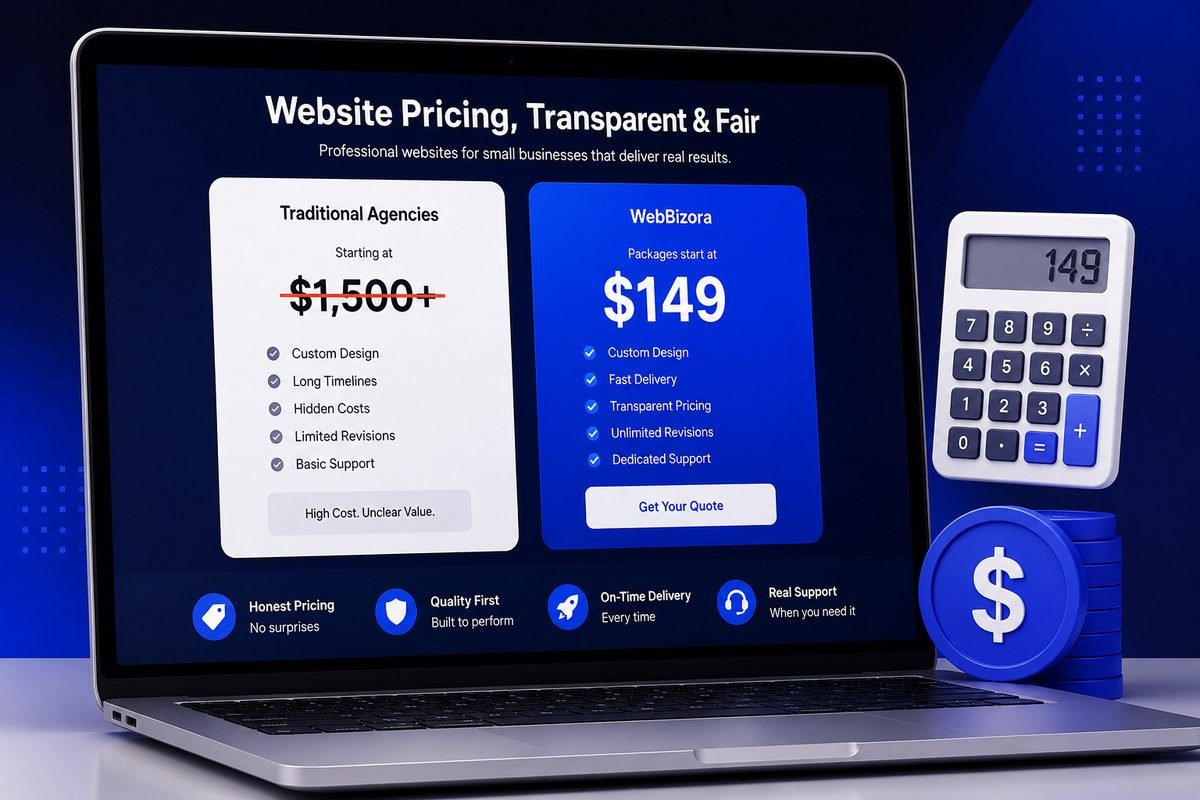
Get three quotes for a new business website and they might come back at $150, $3,000 and $12,000. That's not a scam and it's not random. Those numbers are describing three genuinely different products.
A small business website in 2026 typically costs $1,000 to $10,000 from a freelancer or small studio and $5,000 to $15,000 from an agency, with the wide spread driven mainly by page count, whether content writing is included, and whether an ongoing monthly retainer is bundled into the quote.
What the Market Actually Charges
Pull up a dozen independent 2026 web-design-cost guides and a pattern shows up fast. A basic 5-8 page site through a freelancer or small agency: $2,000 to $5,000. A fuller 10-20 page custom build: $5,000 to $15,000. Custom e-commerce starts around $5,000 and keeps climbing past $40,000 depending on what it needs to do. Clutch's 2026 survey data puts most reviewed projects under $10,000 — which sounds almost reasonable until you remember "under $10,000" and "$150" aren't in the same universe.
Where That Price Actually Goes
None of this is padding for no reason. A traditional agency's quote is paying for a discovery phase that can run several weeks of calls before any design work starts, a project manager coordinating between departments, custom illustration work, and office overhead baked into every project regardless of size. For a genuinely large, multi-stakeholder project, that structure earns its price.
“A $150 quote and a $10,000 quote can both be honest quotes. They're just quoting different jobs.”
What Changes the Number for a Smaller Business
A small business needing a clear, professional site isn't running a multi-department platform, so it shouldn't be paying for one. That's the actual gap WebBizora is built around — an AI-enhanced workflow strips out the repetitive technical build work agencies price heavily for, and leaves the parts that genuinely need a person (strategy, design direction, final review) untouched. Which is why pricing starts at $1,199. Not a discount on a lesser product. A leaner way of building the same one.
What to Actually Compare When You Get Quotes
Skip the price-only comparison. Look at page count, whether the design is genuinely custom or a re-skinned template, how many revision rounds are built in, and what happens if something breaks after launch. A $150 quote and a $10,000 quote can both be honest — they're just describing different scopes of work, and the right one depends on what the business actually needs.
A Quick Way to Sanity-Check Any Quote You Receive
If a number comes in dramatically under the researched range for a comparable job, ask directly what's different. Smaller page count? Template-based? No revisions? Or genuinely a more efficient process? A provider who answers specifically is usually being straight with you. One who gets vague is worth a second look, whatever the number.
Key Takeaways
- Traditional agencies typically charge $2,000-$15,000+ for a small-business site, per a dozen-plus independent 2026 pricing guides.
- Most of that price is discovery calls and project-management layers, not necessarily better design.
- An AI-enhanced workflow can cut that overhead while keeping a person on strategy and design.
- Compare scope first — pages, custom vs. template, revisions, support — then compare price.
Quick Answers
Different cost structures. A traditional agency's price bakes in discovery calls, management layers, and office overhead. A leaner, AI-enhanced workflow cuts much of that while keeping a person on strategy and design.
Not automatically. Compare what's actually included — pages, custom design vs. template, revisions, support — rather than price alone. A lower number can mean a more efficient process, not a worse product.
At minimum: a handful of core pages, mobile-responsive design, a working contact method, basic search visibility. Beyond that it depends on the business — see the full breakdown for what's in each tier.
Ready to Talk About Your Own Website?
Straight answers, no pressure — tell us what you're building.
More From the Blog
What a Real Estate Website Costs — and Why the Listings Often Cannot Be Found
Quotes run from $200 to $25,000, and the line item that breaks most of them is IDX. Worse, the way IDX is usually installed hides your listing pages from Google entirely.
Read Article
What a Law Firm Website Actually Costs — and Who Ends Up Owning It
Quotes run from $1,000 to $100,000 for what sounds like the same thing. The number matters less than a question most firms never ask until they try to leave.
Read Article
A Year of the European Accessibility Act: What Actually Happened
Enforcement began in June 2025. A year later the picture is genuinely mixed — real court action, real investigations, and, depending on which source you trust, possibly not a single fine.
Read Article